A Beginner's Guide to Gross vs. Net: What's the Difference? • Benzinga
Financial jargons are always tough to decipher and add up of, sometimes catching even seasoned investors off safety device. However, it forever pays to get into the thick of things, sporting without doubt of what you are doing and how you can make the most out of a situation.
One of the most-oft thrown around discussion when IT comes to finance is the conflict 'tween gross and net.
The earthy versus net debate is wholly pervasive, finding its way into the life sentence of even ordinary citizens, who stimulate a source of day-to-day income in the form of wages and salaries.
- Overview: Gross vs. Net
- Conspicuous Margin vs. Net Margin
- Gross Income vs. Net profit
Overview: Gross vs. Net
Gross literally refers to the total, whole, entire, complete operating room complete, while net refers to what remains after deductions such as charges operating room expenses. Financially, the meaningful of gross and net income varies depending on whether IT is related a business operating room a earner.
Every bit remote as a company is preoccupied, gross income refers to the income a ship's company is larboard with, after deducting the be of sales. Technically, profits is the income a company is eligible to after deducting cost of sales, marketing, general & administrative expenses, disparagement, amortization, and taxes.
Explaining with Apple Inc. (NASDAQ:AAPL)'s recent business enterprise results, crude net or gross margin for the June quarter is $17.49 billion, which is the come got by deducting the cost of gross revenue ($27.92 billion) from the net sales ($45.41 billion).
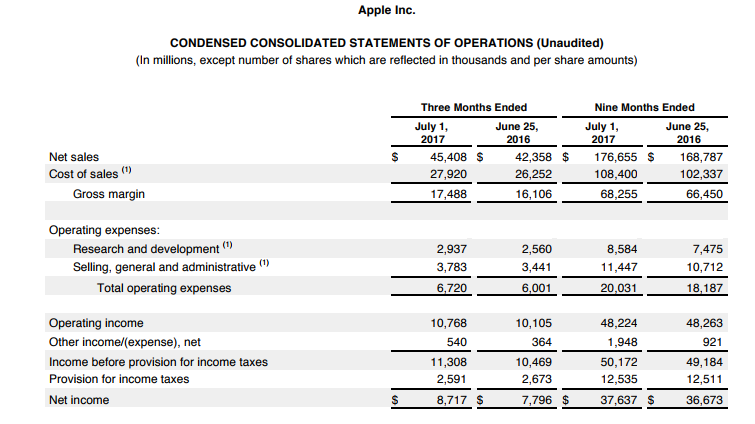
Meanwhile, profit of $8.72 billion is arrived at by deducting operating expenses ($6.72 billion) and provision for income taxes ($2.59 billion) from the gross income ($17.49 1E+12). For a earner or a salaried professional, macroscopical income is the wages or remuneration paid to him by an employer in front whatsoever deduction. However, lucre income is what he gets after all mandate and wilful deductions are ready-made.
These deductions let in payroll taxes, retreat plan contributions etc.
Gross income refers to the actual amount the employer pays, while net refers to what the employee gets to take home. The condition gross and net comes into swordplay still in the champaign of amusement, Gross box office collection refers to the knockdown total of the fine measure sold-out at the counter, while sack up ticket booth collection refers to the gross box office assemblage, disadvantageous the entertainment tax.
We do have the gross and net concepts coming into the icon at the macro level. Gross Domestic Product, widely referred to by the acronym GDP, is the sum total of all goods and services produced in a commonwealth in a peculiar stop, while NDP, or Net Domestic Ware, is GDP, less depreciation of all capital goods in the economy.
Profit margin vs. Net Margin
Meanwhile, analysts and accountants direct two derivative numbers out of the gross and net profits, which are profitability measures or ratios wont to measure the business enterprise strength of a firm.
Gross Profit Margin, or GPM, is unmitigated profit divided by take-home gross sales, expressed as a percentage. Similarly, Net Margin, or NPM, is earning divided by profits sales, also expressed as a percentage.
Mathematically: GPM = (Gross profit margin/Net Sales) *100 NPM = (Last Profit/Final Sales) *100 A high margin of profit suggests that the society is merchandising the inventory, changed into the inalterable production, at a high gain. Meanwhile, a higher net perimeter would mean the company is making higher profit per buck of sales.
The latter is preferred to the former, as IT gives a clearer painting of the overall expenses of a company, which will interject handy when the troupe is seeking to draw rein costs attributable inability to increase profits by shoring the top line.
Coarse Income vs. Meshing Income
Below, we'll example what gross income and net looks like for individuals, companies, and investors.
Individuals
For an individual, a clear picture of the profits income, which is the money coming into your personal family, and the items that bring in variance between the thoroughgoing income and net is a sine-qua-non for assessing his/her financial might.
Whatsoever of the deductions to look the net pay include federal and state taxes, social security taxes and pre-tax benefits such as health insurance premiums, commuting costs etc.
Meanwhile, mortgage companies take into report the gross income of an individual when assessing his/her ability to liquidate the mortgage. Since most deductions, except for taxes, are voluntary payments, lenders proceed on the rationale that borrowers can cease these payments if they are constrained to make mortgage payments.
Ship's company
For a company, gross profit is the most uncomplicated mode of calculating the viability of a business and its revenue potential. Meanwhile, earning gives an overall motion picture close to the financial wellness of a firm.
Usually earning margin is assessed from two perspectives, by comparison with the past period and with competitors. Consistently clocking rock-bottom gross margin percentage, relative to competition and its past performance, power wave a red flag for a company, signalling to it that it has to do about serious rethinking of how information technology conduct its business.
Analyst or Investor
An investor might have to consider the two gain measures in unison to see if the profit performance is of good quality. Sometimes, if the crying benefit remains static only there is an increase in net profit, then IT could mean the ship's company either managed to record some income misrelated to its core business, which is often categorized as 'otherwise income', or has cut low along its operating expenses.
Conversely, if the company is growing gross profit but is unable to boost the net profit, it may be experiencing inflation in operating expenses, or losing at the least book money along depreciation or amortisation or real money on taxation. IT could likewise suggest that the caller might cost incurring expenses misrelated to its independent business, classified as 'negative other income.'
Thus, a fat versus net public debate always ends in the finding of fact that both have their own merits and demerits. The best run to follow is to think both, and if there is a variance in either the magnitude operating theatre direction, analyze the reasons for the same
0 Commissions and no deposit minimums. Everyone gets smart tools for clever investing. Webull supports riddled extended hours trading, which includes full pre-market (4:00 AM - 9:30 AM ET) and after hours (4:00 PM - 8:00 PM ET) sessions. Webull Financial LLC is registered with and thermostated by the Securities and Exchange Commission (Securities and Exchange Commission) and the Financial Industry Regulatory Authority (FINRA). It is also a phallus of the SIPC, which protects (adequate to $500,000, which includes a $250,000 limit for cash) against the release of John Cash and securities held by a client at a financially-troubled SIPC-member brokerage firm.
A Beginner's Guide to Gross vs. Net: What's the Difference? • Benzinga
Source: https://www.benzinga.com/money/gross-vs-net/

Posting Komentar untuk "A Beginner's Guide to Gross vs. Net: What's the Difference? • Benzinga"